Julie Tremble LUCABOT
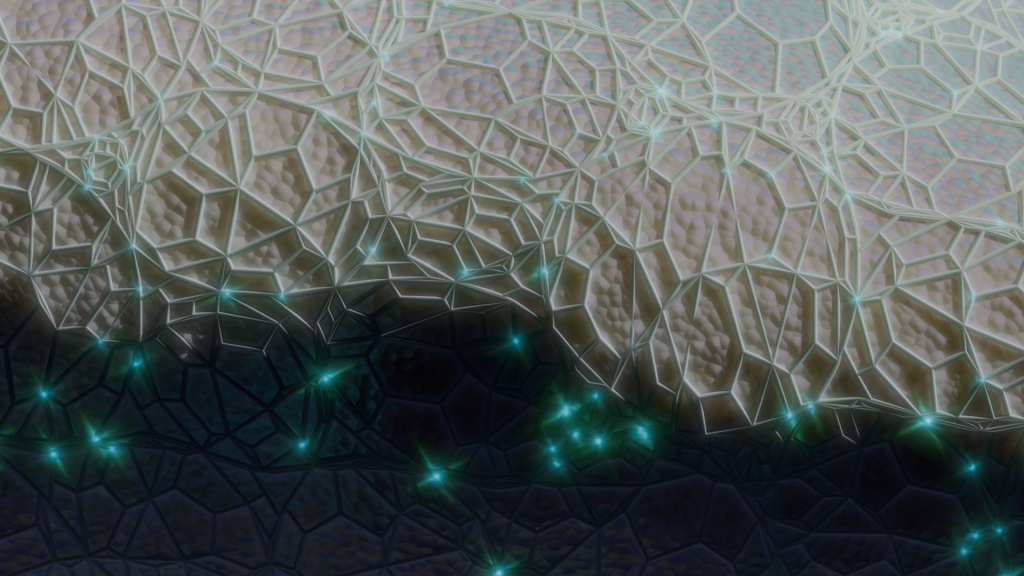
© Julie Tremble, image tirée de la vidéo LUCABOT, 2026
Drawing on current discoveries in cosmology and biochemistry, LUCABOT (2026) is a contemplative science-fiction video that expands Julie Tremble’s research into matter and the cosmos. The work presents a vision of space travel radically different from conventional narratives: intergalactic missions and futuristic spacecraft give way to the abstract story of a minuscule robot-like organism navigating space in search of a DNA signature.
While LUCA refers to the Last Universal Common Ancestor—the cellular ancestor of all life on Earth—LUCABOT offers a fragmented interpretation that moves between the philosophical and the apocalyptic, adopting the scale of life itself rather than a human one. Through this displacement, the work highlights the unity of organic matter and opens a reflection on our relationship to the world beyond misanthropic perspectives, while hinting at socio-ecological and political urgencies.
Combining 3D animation and live-action footage, LUCABOT bridges the microscopic and the immensity of cosmic formations, reminding us that we are shaped by infinite combinations and variations of matter unfolding across time. True to Tremble’s approach, the work avoids a didactic application of scientific theories in art and instead traces a sensitive portrait of the invisible forces that shape our world.
This project was made possible thanks to the financial support of the Conseil des arts et des lettres du Québec.
Further readings:
© Julie Tremble, image tirée de la vidéo LUCABOT, 2026
Julie Tremble holds a master’s degree in film studies from the University of Montreal and a bachelor’s degree combining cinema and philosophy. Her work has been presented in Canada and internationally in art centers including: Dazibao, Galerie B-312, La Fonderie Darling (Montreal), The Factory (Iceland), Museum Ludwig (Budapest), STUDIOTELUS at the Grand Théâtre de Québec and VU (Quebec City), Galerie d’art Foreman and Sporobole (Sherbrooke), as well as at various festivals including the Mirage Festival (Lyon), Les Instants Vidéo (France), the Festival du nouveau cinéma, the International Festival of Films on Art (Montreal), and Images Festival (Toronto). She has also presented her work at multidisciplinary conferences: the biennial meeting of the International Society for the History, Philosophy and Social Studies of Biology (University of Toronto) and Origine de la vie, discours et représentation (Acfas, Université de Montréal). In 2013, she received the CALQ award for best work of art and experimentation at the Rendez-vous Québec Cinéma.
